Skip to content
Shenzhen, China · Service

Motor control and power electronics

Field-oriented drives to 11 kW, sensorless where an encoder is a field-service cost you would rather not carry.

What this solves

  1. A loaded machine has to start without rollback, and open-loop ramping is not acceptable in a passenger system.

  2. One drive has to serve several power classes without per-site retuning by an engineer who has to travel there.

  3. Torque ripple that is invisible in a pump is felt directly by a passenger or an operator.

Outcomes

What is different afterwards

Deliverables are the artefacts you receive. These are the things that are true once the work is done.

  1. A loaded machine starts without rollback, with no encoder to fail in the field

  2. One drive serves several power classes without an engineer travelling to retune it

  3. Protection is verified against real fault events on the bench, not asserted in a datasheet

Datasheet

What we have actually shipped

Every figure here is one already delivered on a published project. Check your requirement against it before you write to us.

Max drive power shipped
11 kW
Control
FOC and DTC, sensorless startup, field weakening
Silicon
TMS320F28 DSP
Feedback
ABZ, sinusoidal and serial encoders — or none
Protection
Desaturation and short-circuit, verified on the bench
Validation
Dynamometer record at each power class before any site work
Method

How we work on this

What we actually do

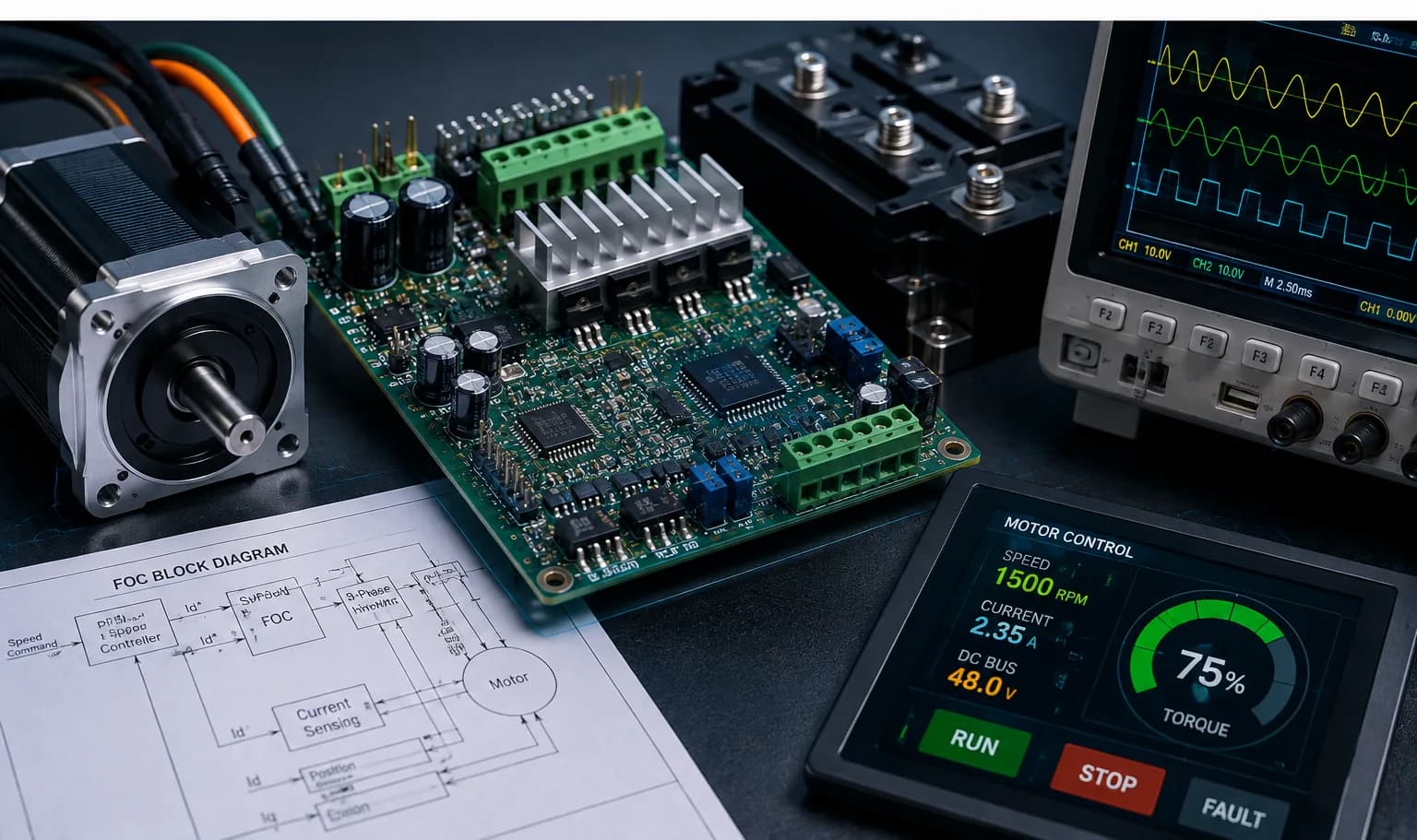
Field-oriented control on motor-control DSPs, with the current loop fast enough that the outer loops have something stable to sit on. Where an encoder is a recurring field-service cost, sensorless startup replaces it — using initial rotor position detection before torque release rather than ramping through the rollback window.

Wide operating envelopes

Motor characteristics held as profiles and blended at runtime let one firmware image serve several power classes, which removes the per-site commissioning build and the engineer who would otherwise have to fly out to produce it.

Ride and feel

S-curve jerk limiting on the speed reference, and field weakening above base speed to hold torque across the full travel profile. Torque ripple that a pump would tolerate is felt directly in a passenger system, so the acceptance bar is set by the person in the car.

Protection

Gate-drive protection is verified against short-circuit and desaturation events before any load testing, because the first time a fault path is exercised should not be with a machine attached.
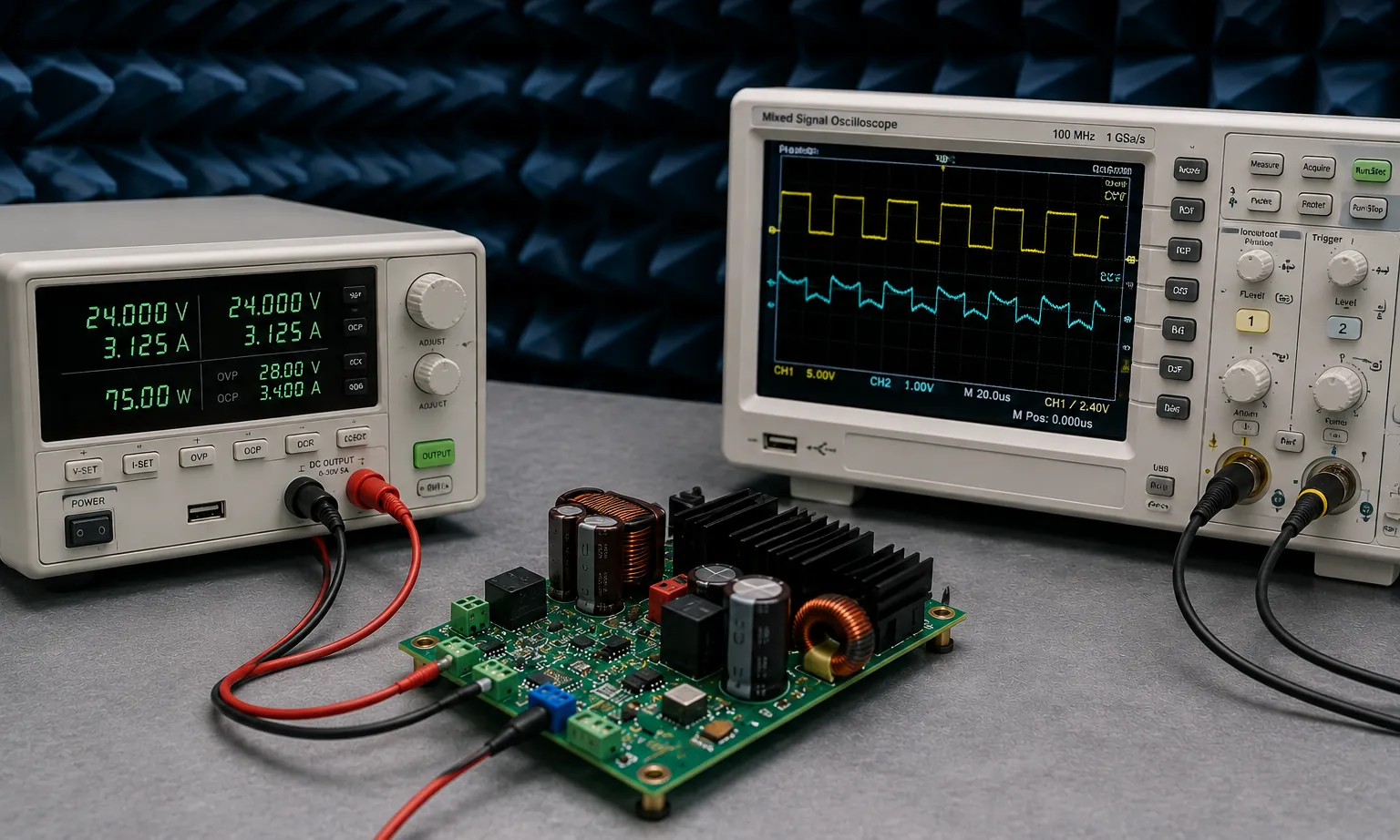
A power converter board on the bench between a programmable supply and an oscilloscope showing the switching waveform
Power stages characterised under load, before any of it reaches a site.

What you receive

Every engagement ends with a complete handover. The design is yours.

  • Firmware with the control structure documented — loops, limits and their tuning
  • Power-stage schematic with protection verified against short-circuit and desaturation events
  • Dynamometer validation record at each power class before any site work
  • Debug tooling that streams live current, flux, torque and position from the drive
  • Commissioning procedure a field technician can follow

Work in this area

1 published
TMS320F28FOC / DTC11 kW

11 kW sensorless AC servo drive

Sensorless field-oriented control at 380 V and 75 A, validated on elevator traction loads from 3.3 to 7.5 kW.

Read the case study →
Questions

What buyers ask us first

Answered here rather than on a call, because the answer does not change and your time is worth more than a discovery meeting.

Why sensorless?
An encoder on a traction machine is a field-service cost and a failure point. Where the load allows it, sensorless startup removes both — the published 11 kW drive holds position at standstill without one.
Can one drive cover our whole product range?
That is usually the requirement worth engineering for. Per-site tuning means sending an engineer to every installation, which costs more over a product life than getting the control structure right once.
What proves it works before it reaches a site?
A dynamometer validation record at each power class. Commissioning a passenger or process machine on site, with the load attached, is not a test — it is a hope.

Platforms we work with

  • TMS320F28 DSP
  • FOC
  • DTC
  • Sensorless startup
  • Field weakening
  • S-curve profiling
  • ABZ / sinusoidal / serial encoders
  • IGBT / MOSFET drive
  • Desaturation protection
  • CAN / LIN
  • Keil

Next step

Send us the hard part.

A schematic, a spec, or a rough idea. We’ll come back within one business day with an honest read on feasibility, risk and timeline.