Skip to content
Shenzhen, China · Service

IoT and wireless systems

Connected devices that survive a week on a small cell — electronics, firmware, radio and the companion app from one team.

What this solves

  1. The device has to stay discoverable and keep logging, and the power budget does not survive either.

  2. Electronics, firmware, radio and two mobile apps sit with four suppliers and nobody owns the whole chain.

  3. Records have to survive power loss and out-of-range periods, then reconcile without duplicates.

Outcomes

What is different afterwards

Deliverables are the artefacts you receive. These are the things that are true once the work is done.

  1. The power budget is measured across every device state rather than estimated from datasheets

  2. One protocol specification covers both mobile platforms, so the apps cannot drift apart

  3. Records survive power loss and out-of-range periods, and reconcile without duplicates

Datasheet

What we have actually shipped

Every figure here is one already delivered on a published project. Check your requirement against it before you write to us.

Radios
BLE, Wi-Fi, LoRaWAN, Zigbee, LTE / GSM
Lowest idle current shipped
Under 5 µA
Silicon
nRF52, ESP32
Power
Li-ion charge management, measured state-by-state current profile
Applications
Native iOS and Android against one protocol specification
Validation
Battery life against an accelerated usage cycle, not a datasheet estimate
Method

How we work on this

What we actually do

The interesting constraint in a connected product is almost never the radio. It is the power budget the radio has to live inside, and the fact that the device will spend most of its life disconnected and still has to be correct when it reconnects.

Power

Getting idle current below a few microamps is an auditing exercise, not a clever trick: pull-up sizing, unused peripheral clock gating, regulator quiescent draw, level-shifter selection. We measure the current profile across every device state with a source-measure unit rather than estimating it from datasheets, because the datasheet figure and the board figure are rarely the same number.

Data integrity offline

Events are logged locally with sequence numbers so records queue on-device during disconnection and reconcile idempotently when the link returns. A dose, a reading or a usage event that quietly duplicates on reconnect is worse than one that is missing, because it is harder to notice.

The whole chain

Electronics, firmware, radio profile and both mobile applications from one team, built against a shared protocol specification so the two platforms cannot drift apart.
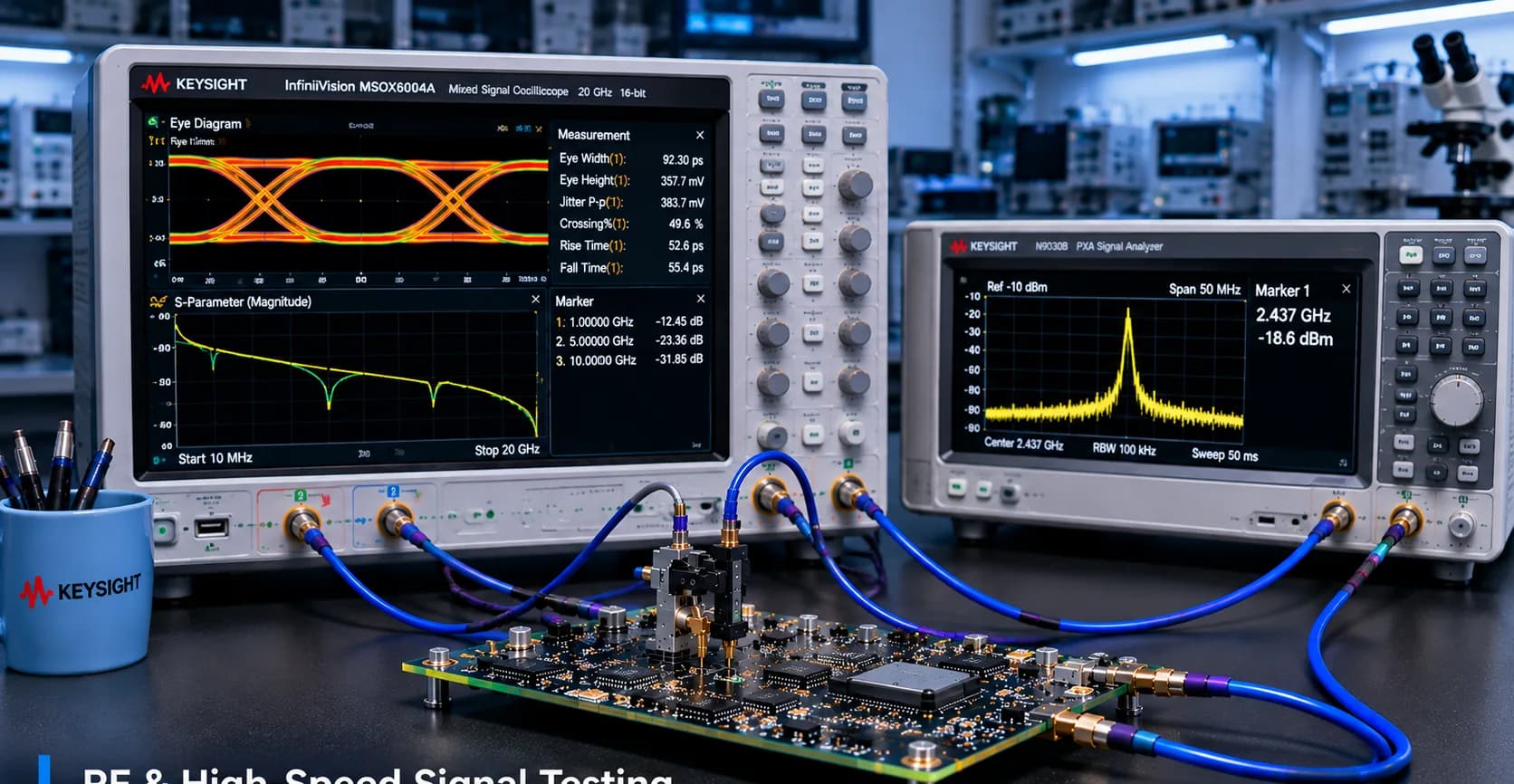
A radio board connected to a spectrum analyser and an oscilloscope showing an eye diagram
Radio and high-speed signal testing on the bench, not from a datasheet.

What you receive

Every engagement ends with a complete handover. The design is yours.

  • Schematic and PCB with the RF section laid out properly, not as an afterthought
  • Firmware with a measured current profile across every device state
  • A documented GATT or equivalent protocol specification both app platforms build against
  • Native iOS and Android applications, written against that one specification
  • Battery-life projection validated against an accelerated usage cycle, not a datasheet estimate

Work in this area

1 published
BLEsub-5 µAiOS + Android

Sub-5 µA BLE sensor node with companion app

A connected dosing device with flash-backed event logging, native iOS and Android apps, and idle current held below 5 µA.

Read the case study →
Questions

What buyers ask us first

Answered here rather than on a call, because the answer does not change and your time is worth more than a discovery meeting.

Do you build the mobile apps too?
Yes, native on both platforms, written against one documented protocol specification. Two app teams interpreting a protocol independently is how a field fleet ends up with two incompatible behaviours.
How do you get idle current that low?
By measuring every device state instead of adding up datasheet figures, then auditing each leakage path — pull-ups, unclocked peripherals, regulator quiescent current. The published sensor-node case holds idle under 5 µA.
Who owns the RF layout?
We do. The RF section is laid out as part of the board rather than fitted around a layout that is already finished, which is the difference between a radio that meets its link budget and one that needs a shield can to survive.

Platforms we work with

  • BLE
  • Wi-Fi
  • LoRaWAN
  • Zigbee
  • LTE / GSM
  • nRF52
  • ESP32
  • Li-ion charge management
  • RF layout
  • Xcode
  • Android Studio

Next step

Send us the hard part.

A schematic, a spec, or a rough idea. We’ll come back within one business day with an honest read on feasibility, risk and timeline.